Pages

Unlocking the World for AI: A Deep Dive into the Model Context Protocol (MCP)

Without tools, even the most advanced foundation model is essentially just a pattern prediction engine. It cannot perceive new data, interact with external systems, or influence its environment. Tools are the "apps" of the AI world, acting as the eyes and hands that allow agents to perform real work.

However, connecting these tools has historically been a fragmented process, requiring custom connectors for every model and application—the "N x M" integration problem. Enter the Model Context Protocol (MCP), an open standard designed to unify how AI agents interact with the world.

What is MCP? The Architecture of Interoperability


MCP is a standard interface that decouples AI agents from the specific implementation details of the tools they use. It utilizes a client-server architecture inspired by the Language Server Protocol (LSP).

The architecture consists of three core components:

  • MCP Host: The application that manages the user experience and orchestrates the agent (e.g., a desktop app or multi-agent system).

  • MCP Client: A component within the Host that maintains connections, issues commands, and manages sessions.

  • MCP Server: The bridge to external systems. It functions as an adapter for data sources or APIs, advertising its capabilities to the client.

Communication is handled via JSON-RPC 2.0 messages over standardized transports, such as stdio for local connections or Streamable HTTP for remote connections.

Beyond Just Tools

While Tools (functions the model can call) are the most widely adopted capability, MCP defines a rich set of primitives:

  • Resources: Contextual data like file contents, database records, or logs provided by the server.

  • Prompts: Reusable templates or examples stored on the server to help clients use tools effectively.

  • Sampling & Elicitation: Client-side capabilities that allow the server to "ask back"—either requesting an LLM completion from the client (Sampling) or asking the human user for input (Elicitation).

The Strategic Benefits of MCP

Adopting MCP offers significant advantages for developers and enterprises building agentic AI:

  1. Solves the Integration Bottleneck: MCP eliminates the need to build a custom connector for every tool-application pairing. By standardizing the communication layer, it reduces development cost and time-to-market.

  2. Modular and Future-Proof Architecture: MCP decouples the agent's reasoning logic from tool implementation. This modularity means you can switch LLM providers or replace backend services without re-architecting your entire integration layer.

  3. Dynamic Tool Discovery: Unlike hard-coded integrations, MCP-enabled applications can discover available tools at runtime. This allows for agents that are more adaptable and autonomous.

  4. Ecosystem Growth: The protocol fosters a "plug-and-play" environment where tools become shareable assets, supported by public registries that allow developers to discover pre-built connectors.

Best Practices for Tool Design

Effective tool use depends heavily on design. Because the tool definition is part of the model's prompt, documentation is the interface.

  • Describe Actions, Not Implementations: Tell the model what to do ("create a bug report"), not how to use the underlying API ("use the create_bug tool").

  • Be Granular: Tools should capture specific tasks rather than thin wrappers around complex APIs. Conciseness helps the model determine when a tool is actually needed.

  • Optimize Output: Avoid returning massive datasets that swamp the context window. Instead, store large data in a temporary table and return a reference ID.

  • Use Error Messages: Treat errors as instructional. If a tool fails, return a descriptive message that guides the LLM on how to fix the request (e.g., "Product ID not found, try searching by name").

The Security Challenge

Connecting agents to the real world introduces new threat vectors. Two major risks include:

  • Dynamic Capability Injection: A server might update its toolset without notification, potentially giving a low-risk agent high-risk capabilities (e.g., a poetry agent suddenly gaining "purchase" rights).

  • Tool Shadowing: A malicious server could define a tool with a name or description similar to a legitimate corporate tool, tricking the agent into sending sensitive data to the wrong place.

  • The Confused Deputy: An attacker can use prompt injection to trick an innocent AI model into commanding a highly privileged MCP server to perform unauthorized actions, like exfiltrating code.

The Path Forward

To make MCP enterprise-ready, organizations must layer security and governance on top of the base protocol:

  1. Centralized Gateways: Use API gateways to enforce policies, such as filtering the list of tools an agent can see based on user identity.

  2. RAG for Tools: To solve context window bloat, future architectures may use a "tool retrieval" step—searching a massive index of tools to load only the relevant definitions into the context window dynamically.

  3. Human-in-the-Loop: High-risk operations (like deleting files) should always require explicit user confirmation, regardless of the tool invoking them.

MCP provides the standard for interoperability, but it is up to the enterprise to build the secure, auditable framework required to deploy it safely at scale.

Source White Paper


Beyond Chatbots: The Rise of Autonomous AI Agents

For years, the conversation around AI has focused on models that excel at passive tasks: answering questions, summarizing text, or generating images. While powerful, these models require constant human direction.

We are now witnessing a paradigm shift. We are moving from AI that predicts content to software that performs actions. Welcome to the era of AI Agents—systems capable of autonomous problem-solving and task execution.


What is an AI Agent?

An agent is not just a language model (LM). It is a complete application that combines reasoning with the ability to act. The document "Introduction to Agents" breaks down the anatomy of an agent into three biological analogies:

  • The Brain (The Model): The central reasoning engine. It processes information and makes decisions.

  • The Hands (Tools): These connect the brain to the outside world. Tools include APIs, code execution, and database access, allowing the agent to "do" things rather than just "say" things.

  • The Nervous System (Orchestration Layer): The governing process that manages memory, planning, and the decision of when to "think" versus when to "act".


The Loop: How Agents Work

Unlike a chatbot that simply replies to a prompt, an agent operates in a continuous loop:

  • Get the Mission: Receive a high-level goal (e.g., "Book travel for my team").

  • Scan the Scene: Perceive the environment and check memory.

  • Think It Through: Devise a plan using reasoning.

  • Take Action: Execute a step using a tool (e.g., check a calendar API).

  • Observe and Iterate: Analyze the result and repeat the loop until the mission is complete.


The 5 Levels of Agent Autonomy

Not all agents are created equal. The document outlines a taxonomy of agentic systems that helps define their capabilities:

  • Level 0: Core Reasoning: A standalone model (like a basic chatbot) acting solely on pre-trained knowledge. It is "blind" to real-time events.

  • Level 1: The Connected Problem-Solver: The model is connected to tools (like Google Search or RAG) to retrieve real-time data and ground its answers in fact.

  • Level 2: The Strategic Problem-Solver: The agent can plan multi-step workflows. It uses "context engineering" to curate information and execute complex chains of thought.

  • Level 3: Collaborative Multi-Agent Systems: A "team of specialists." Instead of one super-agent, a Coordinator agent delegates tasks to specialized agents (e.g., a researcher, a writer, a coder).

  • Level 4: Self-Evolving Agents: The frontier of AI. These agents can identify gaps in their own capabilities and autonomously create new tools or agents to fill them.


Key Benefits for the Enterprise

The shift to agentic architecture offers profound benefits for business and technology leaders:

  • Complex Problem Solving: Agents can handle multi-step, non-linear workflows that previously required human intervention.

  • Reduced Hallucinations: By using tools to retrieve information (RAG) before speaking, agents ground themselves in reality/facts rather than relying solely on training data.

  • Scalability via Specialization: Using a "team of specialists" (Level 3) allows for easier maintenance and better performance than trying to force one model to do everything.

  • Reliability: With "Agent Ops," businesses can treat agents like software products, using traces and logs to debug the agent's "thought process" and ensure reliability.


Future Opportunities: The Agent Economy

As agents mature, they will unlock opportunities that go beyond simple workflow automation.

  • The Agent Economy & Interoperability: Just as humans collaborate, agents will need to talk to one another. The Agent2Agent (A2A) protocol creates a standard "handshake," allowing agents to discover each other and collaborate on tasks. Furthermore, protocols like Agent Payments (AP2) will allow agents to securely negotiate and pay for services on behalf of their users, creating a true machine-to-machine economy.

  • Scientific Discovery: Advanced agents like Google Co-Scientist are already being used to accelerate scientific discovery. These systems act as virtual research collaborators, generating hypotheses, running simulations, and debating ideas to solve complex problems in biology and code.

  • Self-Improving Software: With Level 4 agents (Self-Evolving), we are moving toward software that can improve itself. Systems like AlphaEvolve use evolutionary processes to discover and optimize algorithms, finding solutions that human engineers might miss.


We are no longer just "prompting" AI; we are orchestrating it. The developer's role is shifting from writing explicit logic to setting the scene, selecting the tools, and guiding autonomous actors. By building robust, secure, and observable agentic systems, we are creating a new class of digital team members capable of reasoning, acting, and evolving.


Source Whitepaper 


Patent US10200150B2: Digital radio channel error detection

A method includes determining, at a device, that transmission data indicates that first data was transmitted via a digital radio channel. The method also includes determining, at the device, that reception data indicates that second data was received via the digital radio channel. The first data has a first size that is less than a second size of the second data. The method also includes determining, at the device, whether an error occurred in transmission of the first data based on determining whether each of a plurality of portions of the first data is included at least once in the second data.

Click here for details at USPTO

Click here for details at Google Patents.

Patent US10305697B2: Handling excess travel-related information

Travel-related-information messages (TRIMS) are received from one or more information sources, and information included in the messages is placed into a first (e.g. TPEG™) or second (e.g. TPEG+) group. A determination is made that a first TRIM reporting message including information from the first group will exceed a permissible size, so excess information is removed from the first group and added to the second group, thereby decreasing the size of the first TRIM reporting message to the permissible message size or less. Some or all of the excess information removed from the first group is added to the second group. First and second TRIM reporting messages are generated from information included in the first and second groups. The first and second TRIM reporting messages are transmitted to end-user devices using different service ports.

Click here for details at USPTO.

Click here for details at Google Patents.

Patent US9916756B2: Broadcast traffic information bounding areas

A method includes configuring a plurality of sub-bounding areas within a primary bounding area. An aggregate traffic message includes traffic information aggregated from the sub-bounding areas, and is broadcast throughout the primary bounding area. The roads within the primary bounding area are associated with road classifications, and individual traffic messages associated with those roads are generated. Sub-bounding areas within the primary bounding area are associated with particular road classifications. Individual traffic messages (for particular roads) are selected for inclusion in the aggregate traffic message (broadcast over the primary bounding area) if those messages are associated with a road having a road classification that matches a road classification of a sub-bounding area in which the road is located. The aggregate traffic message is generated by combining the selected individual traffic messages, and is transmitted to a station importer.

Click here for details at USPTO

Click here for details at Google Patents

Book Review: The Art of the Start


I was hesitant to read this book - thinking it is another feel-good, self-help, inspiration, yes you can do it kind of content. However it turned out to be completely different. It is a step-by-step guide for entrepreneur to start a business.  There are 11 chapters each detailing a specific topic - the art of starting, positioning, pitching, pitching, writing a business plan, raising capital, bootstrapping, recruiting, partnering, branding, rainmaking and the being a Mensch. The book should be useful for starting any kind of business but is more geared towards technology start-ups seeking venture capital. The message is clear and simple – Put your passion to work –and the book will guide you to do so.

Quotes

“Entrepreneur is not a job title.  It is a state of mind of people who want to alter the future.”

“The higher you go in big organizations, the thinner the air, and the thinner the air, the most difficult it is to support intelligent life”

“10/20/30 rule of presentations- 10 slides, 20 minutes, 30 font size”

Bozo explosion – “A” players hire "A+" players, but "B" players hire "C", "C" hire "D", etc..”

“Beware of the "successful bozo" wearing a nice suit - People automatically equate rich with smart"

“10 slides of VC presentation – Title, marketing and sales, problem, solution, competition, team, business model, projections, underlying magic, status and timeline”

“You should always be selling—not strategizing about selling. Don’t test, test, test—that’s a game for big companies. Don’t worry about being embarrassed. Don’t wait to develop the perfect product or service. Good enough is good enough. There will be plenty of time for refinement later. It’s not how great you start—it’s how great you end up.”

“And doing, not learning to do, is the essence of entrepreneurship.”

“The wisest course of action is to take your best shot with a prototype, immediately get it to market, and iterate quickly. If you wait for ideal circumstances in which you have all the information you need (which is impossible), the market will pass you by.

“Make the world a better place. Increase the quality of life. Right a terrible wrong. Prevent the end of something good.”

“Everyone should carefully observe which way his heart draws him, and then choose that way with all his strength.”

Book Review: The Magic of Thinking Big


The whole book can be summarized in just one sentence: You are what you think you are – so think big and be successful. There is no other success mantra in the book – if you are feeling low, pessimistic or need some motivation go ahead and read the book.

Quotes

“A wise man will be master of His Mind. A Fool will be Its Slave."

“Look at things not as they are, but as they can be. Visualization adds value to everything. A big thinker always visualizes what can be done in the future. He isn't stuck with the present”

"Remind yourself regularly that you are better than you think you are. Successful people are not superhuman. Success does not require a super-intellect. Nor is there anything mystical about success. And success doesn't based on luck. Successful people are just ordinary folks who have developed belief in themselves and what they do. Never -- yes, never -- sell yourself short."

“Build castles, don't dig graves.”

“If you want something done give it to a busy person” (not a person who has a lot of time. Most likely the person will like to keep that way).

“Hope is a start. But hope needs action to win victories”

“Action cures fear.”

“Look at things as they can be, not as they are.”

“Whether the psychological problem is big or little, the cure comes when one learns to quit drawing negative form one's memory bank and withdraws positive instead”

“Those who believe they can move mountains, do. Those who believe they can't cannot.”

“The thinking that guides your intelligence is much more important than how much intelligence you have”

“Belief triggers the power to do.”

"The test of a successful person is not an ability to eliminate all problems before they arise, but to meet and work out difficulties when they do arise. We must be willing to make an intelligent compromise with perfection lest we wait forever before taking action. It's still good advice to cross bridges as we come to them."

"Believe Big. The size of your success is determined by the size of your belief. Think little goals and expect little achievements. Think big goals and win big success. Remember this, too! Big ideas and big plans are often easier -- certainly no more difficult - than small ideas and small plans."

"How we think shows through in how we act. Attitudes are mirrors of the mind. They reflect thinking." 

“Knowledge is power only when put to use - and then only when the use made of it is constructive.”

“But there's another type of poison perhaps a little more insidious - thought poison - commonly called "gossip." Thought poison differs from body poison in two ways. It affects the mind, not the body, and it is more subtle. The person being poisoned usually doesn't know it. Thought-poison is subtle but it accomplishes "big" things. It reduces the size of our thinking by forcing us to concentrate on petty, unimportant things. It warps and twists our thinking about people because it is based on a distortion of facts, and it creates a guilt feeling in us that shows through when we meet the person we've gossiped about. Thought-poison is 0 percent right thinking: it is 100 percent wrong thinking. And contrary to lots of opinion, women have no exclusive franchise on gossip. Every day many men, too, live in a partially poisoned environment.”

“Get the action habit - you do not need to wait until conditions are perfect.”

“There is no such thing as smooth bump free road to success.”

“3 most common excuses of the “Exucites” disease: I don’t have time, my health is not good and I am not that intelligence.”

“Ability to think is much more important than ability to memorize facts”

“Confidence is built and developed. Nobody is born with confidence.”

“Ideas without action is like a car without engine”

“A fair idea is 100% better than a great idea that dies because it is not followed up”

When LinkedIn goes down …

Witty message… instead of getting frustrated makes you laugh.


Workforce Development Using MTConnect

Book Review: The Fault in Our Stars


Favorite Quotes

That's the thing about pain, it demands to be felt

I enjoy looking at beautiful people, and I decided a while ago not to deny myself the simpler pleasures of existence.

Some infinities are bigger than other infinities.

I’d always thought the world was a wish-granting factory.

We find humor where we can.

I believe the universe wants to be noticed. I think the universe is improbably biased toward consciousness, that it rewards intelligence in part because the universe enjoys its elegance being observed. And who am I, living in the middle of history, to tell the universe that it-or my observation of it-is temporary?

That's why I like you ... You are so busy being yourself you have no idea how utterly unprecedented you are.

Oh, I wouldn't mind. It would be a privilege to have my heart broken by you.

Some tourists think Amsterdam is a city of sin, but in truth it is a city of freedom. And in freedom, most people find sin.

I thought being an adult meant knowing what you believe, but that has not been my experience.

Grief does not change you. It reveals you.

You've gotta pick your battles in this world.

I take quite a lot of pride in not knowing what’s cool.

You realize that trying to keep your distance from me will not lessen my affection for you.

No matter how hard you kick, no matter how high you get, you can’t go all the way around.

The weird thing about houses is that they almost always look like nothing is happening inside of them, even though they contain most of our lives. I wondered if that was sort of the point of architecture.

People always get used to beauty.

Our fearlessness shall be our secret weapon.

I’m on a roller coaster that only goes up,' he said. 'And it is my privilege and my responsibility to ride all the way up with you.

There is no try. There is only do.

Ignorance is bliss.

The real heroes anyway aren’t the people doing things; the real heroes are the people noticing things, paying attention.

Don't tell me you're one of those people who become their disease.

Pain is like fabric; the thicker it is, the more its worth.

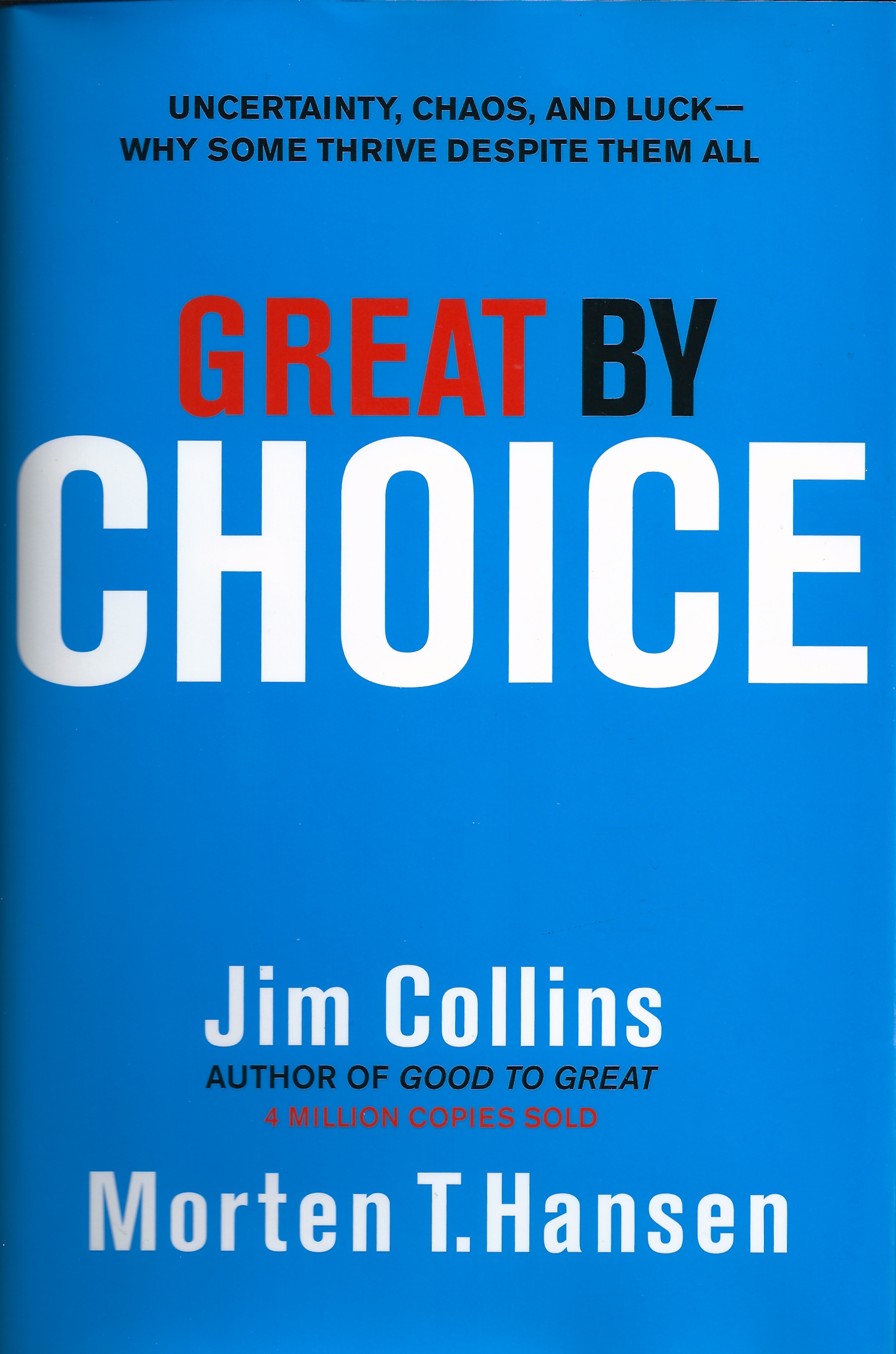
Book Review: Great by Choice


Quotes:

Good is the enemy of great.

The purpose of bureaucracy is to compensate for incompetence and lack of discipline.

Bad decisions made with good intentions, are still bad decisions.

A company should limit its growth based on its ability to attract enough of the right people.

Creativity dies in an disciplined environment.

Great vision without great people is irrelevant.

20 Mile March describes the fanatic discipline that leads you to manage for the long term rather than chasing short-term results or the fade. Three reasons for 20 mile march:

  • Builds confidence 
  • Reduce likelihood of catastrophe 
  • Exert self-control in an out of control environment

It is impossible to have a great life unless it is a meaningful life. And it is very difficult to have a meaningful life without meaningful work.

By definition, it is not possible to everyone to be above the average.

What separates people is not the presence or absence of difficulty, but how they deal with the inevitable difficulties of life.

Letting the wrong people hang around is unfair to all the right people, as they inevitably find themselves compensating for the inadequacies of the wrong people. Worse, it can drive away the best people. Strong performers are intrinsically motivated by performance, and when they see their efforts impeded by carrying extra weight, they eventually become frustrated.

When you marry operating excellence with innovation, you multiply the value of your creativity.

Freely chosen, discipline is absolute freedom.

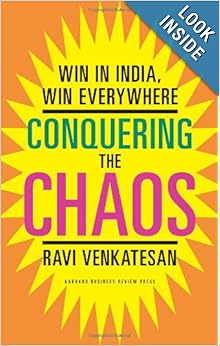
Boom Review: Conquering the Chaos: Win in India, Win Everywhere


This book is written by Ravi Venkatesan, Ex-CEO of Cummins India and Microsoft India. Ravi makes a case of why India is a great destination for multinational corporations (MNC) and associated challenges. According to Ravi, in spite of the well-known issues of poor infrastructure, bureaucracy, red-tape, corruption and land acquisition issues, India presents an excellent opportunity for MNC’s (even if Indian market contributes to less than 1% global revenue for the company). The author argues that there are more benefits than just low cost labor and low cost manufacturing (commonly termed as the offshoring) for setting up operations in India.

Several examples of world class companies like John Deere, Cummins, Nokia, Microsoft, Samsung and Unilever are included with case studies. One example stands out – John Deere and Mahindra. Mahindra has a majority of market share in India when it comes to low horse power tractors. Recently, Mahindra was also challenging John Deere in their strong foothold market in the some western countries by introducing low cost (but value) products. John Deere was losing on home front and also on foreign turf. For John Deere, all aspect from design to manufacturing to marketing were controlled from the headquarters. In the light of changed market conditions, John Deere decided to open a new facility in Pune, India for developing low power-low cost tractors. All aspects of the product development were managed form the Pune facility. The strategy paid off – John introduced a new tractor specifically tailored to the developing market like India. They were able to penetrate the market and claim a sizable market share. Additionally, they were able to launch modified version of these products on the home front to regain the lost share in the developed markets. Thus, by expanding in India and taking the competitors head-on, John Deere acquired essential skills and capabilities to innovate and develop tailored products.

For the India strategy to succeed, the author suggests a few tips:
- Instead of a strong headquarter control where every small policy and directive is issued, the author suggest to have some local autonomy for the Indian executives. Many MNCs control each and every aspect of business from the headquarter normally located in its parent country. The author argues that such a model is detrimental for India operations due to the differences in the cultures, business, political and social structures with respect to a typical western country. The strategies which  work well in a developed western country do not necessarily apply in India.
- Many MNC try to standardize and use the “one size fit all” model. This might need some change – Indian customers are not necessary ready to pay premium prices for premium brands – A typical Indian customer will look at the value versus allied services and brand name. For example, the sachet  size shampoos and conditioners packaging.
- The most important point which was highlighted in the book was – Use India as a testing ground for other developing countries. The author argues that skills a company will acquire as they work in India will be useful for other developing countries which ,might have even adverse conditions. If the company is successful is India, it can easily replicate the strategies in other developing countries, expanding their reach and market potential.
- Strategies to work with local politicians, corruption and red tape are interesting.
- Author’s views and suggestions of entering the Indian market with acquisition or joint venture with an Indian company are noteworthy.

Manufacturing Future with MTConnect + Google Glass + iBlue


The advent of MTConnect has revolutionized the manufacturing industry where propriety software and closed systems was common. MTConnect is an open, royalty-free standard that is intended to foster greater interoperability between devices and software applications.  By establishing an open and extensible channel of communication for plug-and-play interconnectivity between devices, equipment and systems, MTConnect allows sources to exchange and understand each other’s data.  This common communication is facilitated by XML and HTTP technology to provide real-time data from throughout a factory.  This common communication empowers software developers to implement applications aimed at providing more efficient operations, improved production optimization and increased productivity.

The presentation will focus on two MTConnect complaint “apps” which provide a holistic view of your manufacturing operations i.e. iBlue for real-time data collection and Google Glass for real-time data visualization.

iBlue, the world's first MTConnect enabled industrial Bluetooth transmitter lets you wirelessly acquire, record, and share manufacturing shop floor data by connecting to your computer, tablet or smartphone device. The (free) mobile application allows users to perform various tasks including check material hardness, temperature, and collect data with an easy to use interface.

Additionally, MTConnect enabled application developed for “wearable” Google Glass technology ensures that the information is available anytime and anywhere. Google Glass is a combination of computer and display, camera, touchpad, microphone, email, and Internet connection, all consolidated into an eyeglass frame, which maximize the benefits of “augmented reality”. One can monitor real-time machine information including but not limited to Power Status, Emergency Stop, Alarm/Messages, Block, Controller Mode, Line, Program, Execution, Path Feed-Rate, Spindle, Axis Positions, Spindle Overrides, Feed-Rate Overrides, Machine Location, Part Location, and Current Part Status. Also, if the machine is outfitted with a camera, Google Glass will stream video to the user and overlay the machine data so the user can compare, analyze, and decide.

Additional business-related data can be viewed by integrating functions such as purchase order management, master scheduling, material requirement planning and shop floor control with other business functions such as accounting, sales, maintenance and shipping. Benefits include real time production dashboard, alerts, equipment availability and usage, overall equipment effectiveness, production reporting/tracking, visualization of maintenance tracking, problem resolution and planning, energy conservation, quality, statistical process control, data mining, genealogy and security.

The presentation will highlight a case study describing the economics of using MTConnect compliant “apps” at a gear manufacturing factory along with benefits, limitations, return-on-investment, and future work.


Reference: Manufacturing Future with MTConnect + Google Glass + iBlue; Deshpande A., Neidig J.; IMTS 2014 Conference, Chicago IL, Sep 2014.